Tyre Sidewall Explained: Size, Speed Rating & Key Markings for Saudi Roads
- May 25, 2026
A
Reviewed By
Ahmed
Automotive Products Specialist, PowerTire
Ahmed supports operations at PowerTire, helping customers choose quality tyres and automotive products. He ensures reliable service and a seamless buying experience for every customer.
Reviewed on May 25, 2026
One of the important features that you must check when you buy car tyres is the code on the sidewall of a tyre. That alphanumeric code stamped on it gives details of everything from size and load capacity to speed rating. All these specs determine whether a tyre suits your vehicle. Once you know how to read it then picking the right fit gets a lot easier.
What Are Tyre Sidewall Markings?
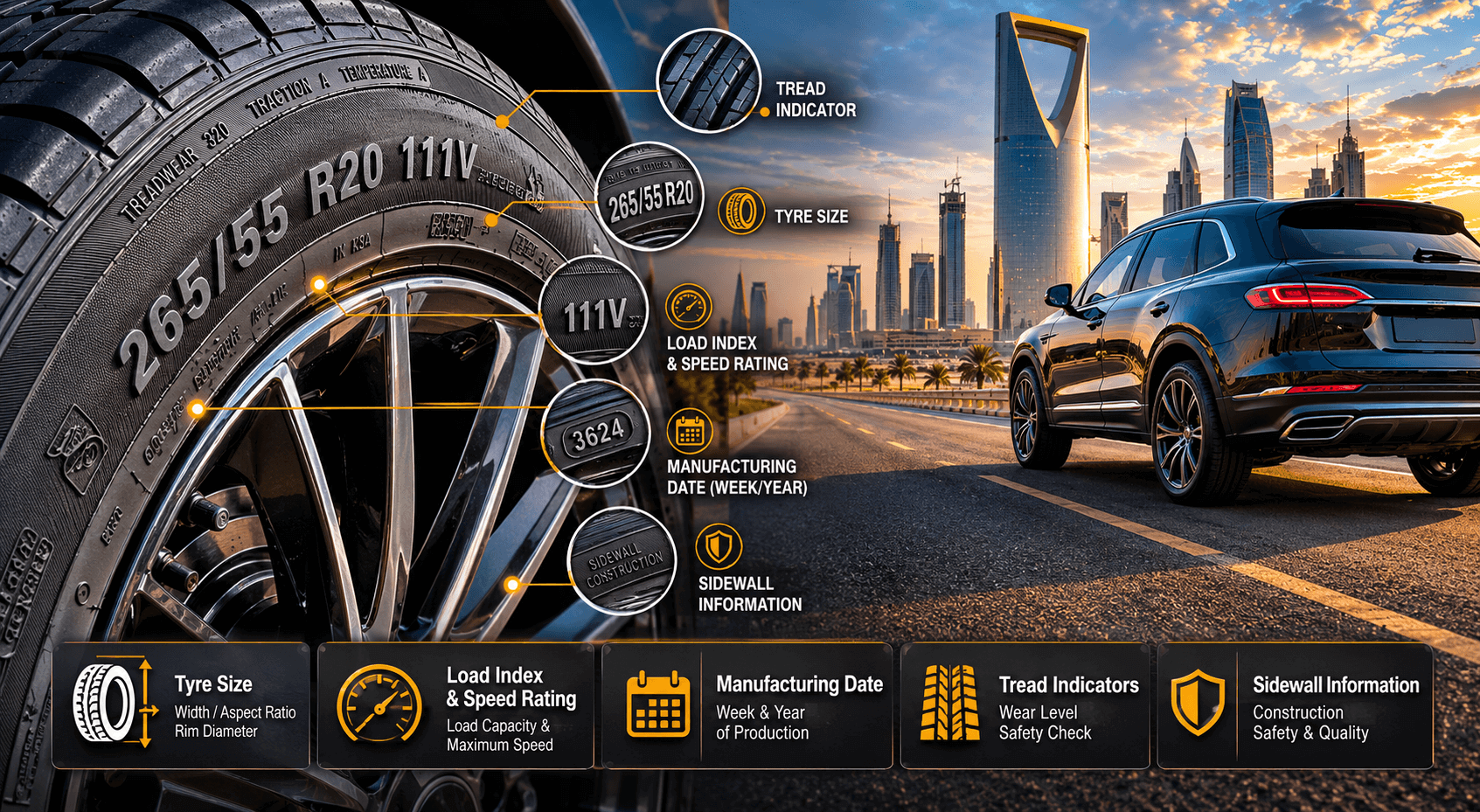
Manufacturers print a series of codes, ratings and labels on the sidewalls of the tyre that tell you everything about that tyre's capabilities and origin. Each code describes size, structure, capacity, safety ratings and more about the tyre. Let us understand it with an example.
Example Of A Tyre Sidewall Code - 225/60 R17 91H.
| Marking | What It Represents |
|---|---|
| 225 | width in millimetres |
| 60 | Aspect ratio — sidewall height as % of width |
| R | Radial construction |
| 17 | Rim diameter in inches |
| 91 | Load index |
| H | Speed rating |
Here is a clear breakdown of these markings along with other details found on the tyre sidewall.
How To Read Tyre Sidewall Markings
You will be able to read the sidewall of a tyre once you know what each section means. Below are the key markings that you will find on the tyre of car.
-
Brand Name
The most prominent text on the sidewall is the name of the manufacturer and appears in large lettering on the outer face and follows strict quality standards.
-
Model Or Pattern Code
Just below or beside the tyre brand name, you will find the tyre model like Michelin Pilot Sport 5 or Bridgestone Dueler H/T. The pattern code hints at the tyre's intended use where H/T means highway terrain, A/T is all-terrain and so on.
-
Tyre Size Code
This is the alphanumeric string like 225/60 R17 91H which is explained in the above section.
- Section Width: Wider tyres offer better grip yet may reduce fuel efficiency
- Aspect Ratio: Lower ratio gives better handling, ride feels stiffer
- Construction Type: Most modern tyres use radial structure
- Rim Diameter: Must match wheel size exactly
-
Load Index
It is a two or three-digit number that shows the maximum weight one tyre carries safely at maximum inflation. Here is a quick reference-
Load Index Max Load (kg) 88 560 kg 91 615 kg 95 690 kg 100 800 kg 106 950 kg Drivers in Saudi Arabia carrying heavy loads on long stretches should check this number carefully.
-
Safety Rating
The letter next to the load index tells you the maximum safe speed for the tyre. Highways in Saudi Arabia have speed limits between 120–140 km/h and so an T or H-rated tyre works.
- T - 190 km/h
- H - 210 km/h
- V - 240 km/h
- W - 270 km/h
- Y - 300 km/h
- Z - Above 240 km/h (varies by model)
-
Tyre Construction Markings
There are usually 5 different construction markings.
- Radial (R) - The standard for modern passenger vehicles. Ply cords run perpendicular to the direction of travel which gives better fuel efficiency and road grip.
- Bias / Diagonal (D or B) - Older construction type, still used in some off-road and commercial tyres. Less common for everyday car tyres.
- Tubeless (TL) - This rating is standard on almost all modern vehicles and means there is no need for an inner tube.
- Tube-type (TT) - This means that an inner tube is required however, it is rare in modern passenger cars.
- Extra Load / Reinforced (XL / RF) - Built to carry heavier loads than a standard tyre of the same size and is common on SUVs and minivans.
-
UTQG Rating
Uniform Tire Quality Grading shows three things-
- Treadwear - It is indicated with a number 300, 500 or 700 and higher. Higher the number, longer is the lifespan of the tyre.
- Traction - Letters AA, A, B or C are mentioned based on wet-surface grip.
- Temperature - A, B or C where A means best heat resistance and C means basic resistance.
-
DOT Code & Manufacturing Date
DOT stands for Department of Transportation and is a four digit code that provides on when it was made. If DOT code is 1026 then it means the tyre was produced in week 10 of 2026.
-
M+S or 3PMSF
M+S (Mud + Snow) - Indicates the tyre meets basic mud and snow traction criteria.
3PMSF - (Three-Peak Mountain Snowflake) A stricter certification for genuine winter performance and is less relevant for most Saudi drivers.
Tips For Choosing The Right Tyres In Saudi Arabia
Selecting car tyres here requires more attention due to heat, long highways and heavy loads.
- High temperature weakens rubber faster and hence always pick tyres with strong heat ratings like grade A.
- If you drive on highways often then go for H or V rating as the lower ratings suit city use only.
- Look for All-Terrain (A/T) tyres with reinforced sidewalls for unpaved or semi-desert terrain.
- Pick the correct load index to avoid stress on tyres as SUVs or family cars carry more weight.
- If you are buying tires online, filter by tyre size first then cross-check load index and speed rating against your vehicle manual.
- Do not choose based on cost alone. A cheaper option may wear out faster and will lead to higher expenses later.
Why Choose PowerTire?
Finding genuine tyres at the right price often feels difficult. At PowerTire, we simplify the process with a focus on convenience and reliability.
- You get access to multiple brands, sizes, patterns
- The car tyre price remains clear with no hidden charges.
- The platform makes selection simple.
- Filters help you pick the correct tyre of car based on size, brand, usage.
- We provide original tyres, reducing risk of early wear or safety issues.
- After purchase, fitting service saves time. No need to search for a workshop separately.
- Options available match local climate needs, including heat-resistant models from leading brands.
Conclusion
Tyre sidewall markings may look complex at first though each code serves a purpose. Once you understand size, load index, speed rating and safety details then choosing the right tyre becomes simple.
Whether you check your current tyre or plan to buy new one then this knowledge helps avoid costly mistakes.
Are you ready to buy car tyres that match your vehicle and road conditions? Browse the full range at PowerTire and filter by exactly what you need.
Frequently Asked Questions
A tyre sidewall displays important details such as tyre size, load index, speed rating, construction type, and manufacturing information. These markings help you choose the correct tyre for your vehicle and driving conditions.
The speed rating indicates the maximum speed a tyre can safely maintain under recommended conditions. Choosing the correct speed rating ensures better safety, performance, and durability on Saudi roads.
The load index shows the maximum weight a tyre can safely carry. Selecting tyres with the correct load index is essential, especially for SUVs, family vehicles, and cars carrying heavy loads.
You can check the tyre's age by looking at the DOT code on the sidewall. The last four digits indicate the week and year the tyre was manufactured, helping you avoid purchasing old stock.
Understanding tyre sidewall markings helps you choose tyres that match your vehicle's specifications and driving needs. It also improves safety, handling, and overall tyre performance on Saudi roads
September 17, 2026
Motorcycle Tyre Rules In Saudi Arabia: Tread, Age And Inspection
September 11, 2026
Michelin LTX vs Bridgestone Dueler- Which Is Better for Saudi SUVs?
Please complete your information below to login.
Sign In
Create New Account